Every scripted series a viewer watches has already lived a long life before its first frame airs. A show is pitched, bought, staffed, written, budgeted, cast, shot, edited and delivered through a pipeline that typically runs many months, and the version that reaches the screen is the residue of hundreds of decisions made by people whose names never appear above the title. Understanding how a television show is made means following that pipeline stage by stage, because each stage leaves a visible fingerprint on the finished episode.
The phrase itself is doing quiet work here. To be behind something, as Merriam-Webster defines one of its senses, is to be in the background of the conditions that produce a visible result, and that is precisely where television production lives: the conditions sit in the background of every scene, shaping what the audience sees without announcing themselves. What follows is a tour of those conditions, from the writers' room to the final edit.
Where does a show actually begin?
Development is the least visible and most decisive stage. A creator or showrunner, the writer who runs the series day to day, brings either a pitch or a spec script to a studio, which is the company that will finance and own the show. If the studio likes it, it buys the idea and takes it to networks and streamers, the buyers. A buyer commits not to a full season but to a pilot, a single prototype episode, plus a handful of backup scripts. That first commitment is deliberately small, because most pilots never become series.
If the pilot performs its real job, which is convincing the buyer that the show can sustain dozens of episodes, the buyer orders a season. The size of that order varies enormously by outlet and era, and the economics behind it, including the tax incentives that increasingly decide where a show shoots, are covered in our explainer on The Federal Production Incentive, Explained: What the New Study Says TV Would Gain. What matters at this stage is simpler: the show now exists on paper as a commitment, and the clock starts. Readers following this should also see The Federal Production Incentive, Explained: What the New Study Says TV Would Gain.
What happens in the writers' room?
Once a season is ordered, the showrunner hires a writers' room, a group of writers who break the season story collectively before anyone drafts a script. The room works in stages that have barely changed in decades: first the season arc, then each episode's story, then the beat-by-beat outline, then the draft. One writer usually takes the assigned episode's outline and writes the first draft alone, and the room then revises it together. The on-screen credit for a given episode often understates how communal the writing was.
The room's output is not just scripts. It produces the show's internal logic, the rules the series will obey, the pace at which mysteries release information, the ratio of standalone episodes to serialized ones. Those structural choices are where a show's identity is actually made, long before a camera exists, which is why a weak room cannot be fixed in the edit and a strong one can survive a mediocre director.
How does a script become a shootable plan?
Pre-production translates pages into logistics. A line producer and unit production manager break every script into its components: locations, sets to build, cast days, stunts, visual effects, crowd scenes, night shoots. Each element costs money, and the department heads, production designer, director of photography, costume designer, and their crews, price and schedule them. The production designer's team either finds real locations or builds sets, and those choices ripple through the whole run of the show, since a standing set built once can be reused for years while a location costs money every time it appears.
Casting happens in parallel. Casting directors run auditions and bring options to the showrunner and the studio, and the leads are usually locked before shooting while guest roles close later. This is also when the director for each block of episodes is hired, and when the schedule is built so that an actor's scenes across several episodes can be shot in one stretch, a practice that saves money and quietly reshapes how the show is directed.
What does a day on set actually look like?
Principal photography is the stage audiences imagine when they picture production, and it is the shortest stage relative to everything around it. The crew shoots in blocks, with each block covering one or two episodes under one director. A shooting day is organized around the call sheet, the daily schedule that lists which scenes are being filmed, when the cast is due, and what the light and weather will allow. The assistant directors run the set's clock; the director of photography runs the image; the director runs the scene's performance and coverage, meaning the arrangement of shots that will let an editor assemble the scene later.
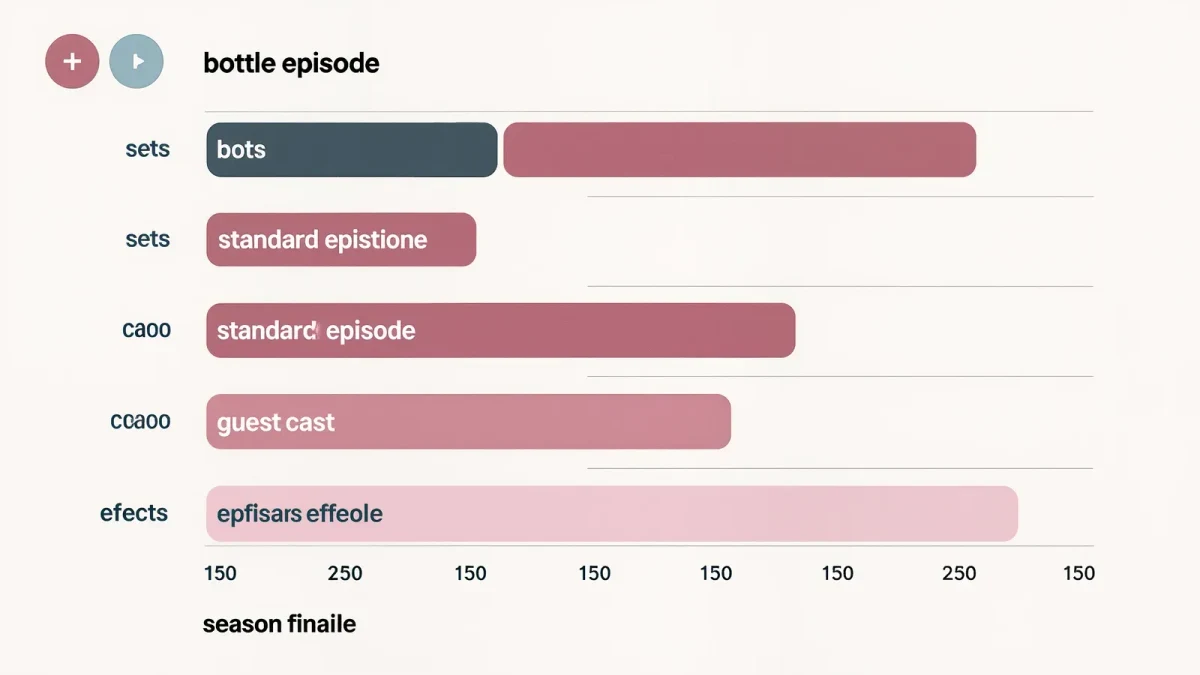
Television's pace is the defining constraint. A feature film may shoot for months; a television episode is typically captured in a matter of days, which forces the format's characteristic trade-offs. It is why the bottle episode, the single-location hour built to contain cost, became a structural tool rather than an accident, a history traced in The Bottle Episode: How TV's Cheapest Hour Became Its Most Prized. Budget pressure does not just limit what a show can show; it shapes the grammar of the show itself.
Why does post-production take so long?
After the cameras stop, the episode enters post-production, and this is where the show is finally, truly made. The editor assembles the footage, choosing takes and building rhythm, and the showrunner gives notes on cut after cut. Then come the layers the audience never thinks about: the composer's score, the sound design, the visual effects shots, the color grade that fixes the episode's look, and the final mix. An episode that shot in eight days can easily spend as long or longer in post, and the difference between a rough cut and a broadcast cut is often the difference between a scene that works and one that doesn't.
Post is also where the delivery machinery engages. The finished master is checked against the buyer's technical specifications, closed captions and localization are produced, and the episode is delivered to the platform or network. Meanwhile the marketing team, which has been operating in parallel the whole time, prepares promos from the finished material. The show the audience finally meets is the last artifact of this chain, not the first.
What this means for how we watch
Our analysis is that the pipeline is best understood as a series of narrowing commitments. Development commits an idea; the pilot commits a prototype; the season order commits a world; the room commits a logic; and post-production commits a tone. A viewer who senses that a show changed between its first and second halves is usually sensing one of these commitments shifting midstream, most often a writers' room recalibrating after seeing what its own episodes actually looked like. The craft of television is not any single one of these stages but the handoffs between them, and the shows that cohere are the ones where each handoff preserved what the previous stage got right.
It also explains why the industry watches the pipeline's early stages so closely. A renewal is decided long before an audience weighs in, on the strength of costs and commitments made during exactly the stages described above, a process unpacked in The Number That Ends a Show: How Renewal Decisions Actually Get Made. The credits roll in under a minute. The decisions behind them take the better part of a year. This connects to our earlier piece, The Number That Ends a Show: How Renewal Decisions Actually Get Made.